New Study Highlights Failure of ADA and Need for Stronger Protections for the Autoimmune Community
Why don’t current disability laws work? And what can we do to fix them?

Washington, DC – 10/14/2024 – A groundbreaking study conducted by Rare Patient Voice and the Workers with Autoimmune Ailments Alliance (WAAA) has revealed the existence of a dangerous gap in disability law. Gaps that contribute to a critical lack of protection for individuals with autoimmune diseases and other invisible illnesses in both the workplace and higher education.
The study, which surveyed 170 participants with autoimmune diseases, found that a significant majority of respondents faced discrimination, difficulty obtaining accommodations, and often the loss of jobs, both due to their illnesses and the way they were treated as a result of them.
The majority said that current protections failed them due to their reactive nature. Only after the act of discrimination is committed is there any attempt to create a clear standard for what they are entitled to. This is inherently backwards. Standards should be set first, and then compliance is easier to judge.
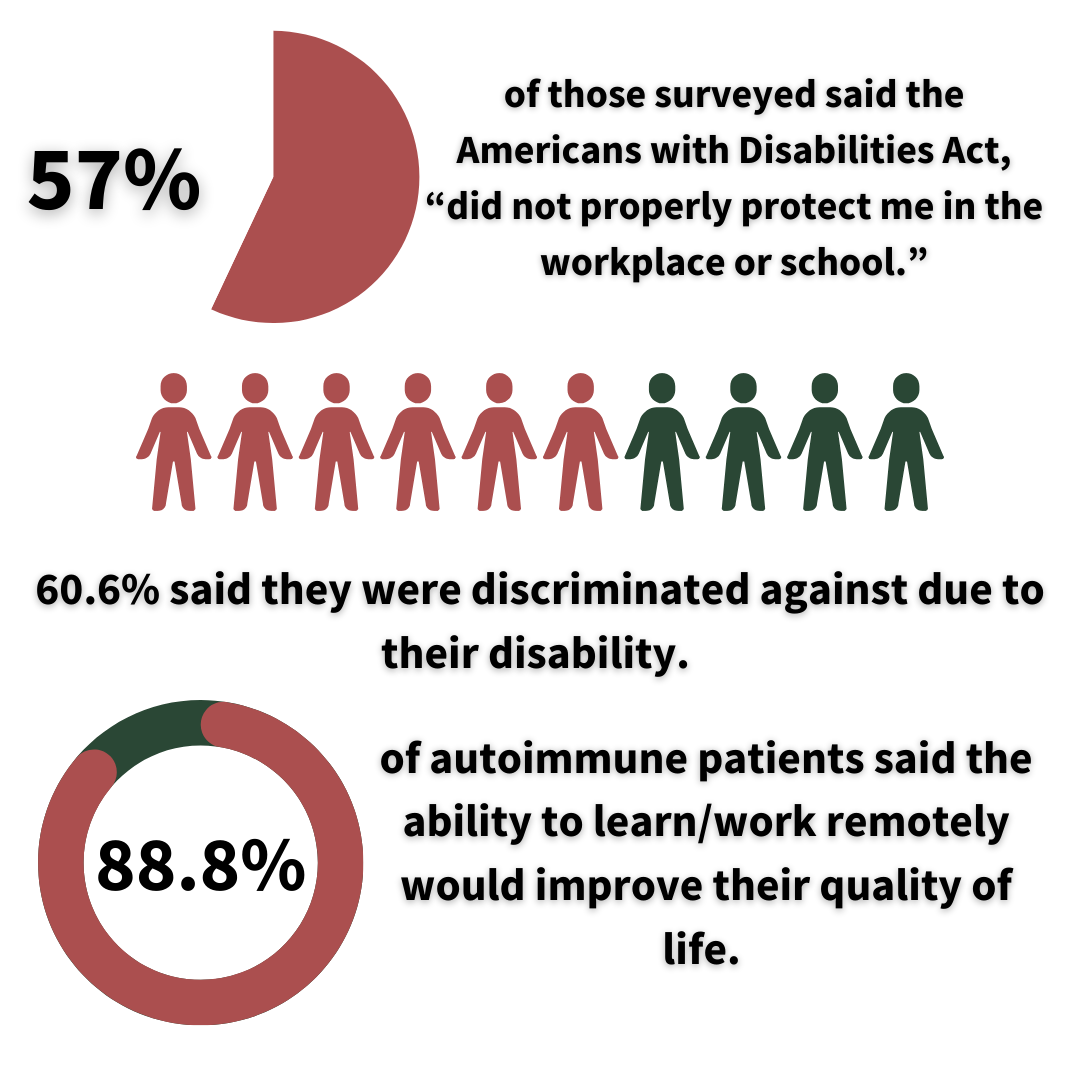
Stats from the RPV study conducted in the summer of 2024. The majority of those with autoimmune illnesses state that discrimination is common.
As of right now, any violation of accommodation law has to be vetted by the EEOC through a long and cumbersome process to determine if an accommodation is truly reasonable. However, there are no clear and explicit standards in place!
This makes it easy for corporations and their high-power lawyers to muddy the water during a trial and prevent workers with disabilities from receiving the help they need. This often means workers must leave their roles. Or keep working despite their disability, putting themselves at risk.
For those with invisible illnesses, this can make safely participating in the workplace almost impossible. These are illnesses that show no physical signs on the outside. Worse, symptom flare-ups are often unpredictable, making it hard for businesses to schedule around.
A mind blowing 38.2% of respondents say they were fired directly because of their autoimmune condition. The picture is even more disturbing when we include the 54.7% of respondents who reported losing their job due to their illness, which includes issues like health-related absences or inability to keep up with work without accommodations.
It’s very hard to deny the existence of a physical disability like cerebral palsy or a broken leg. But for someone with an invisible illness, it is very common for the very existence of their condition to be denied. This is especially common because many invisible illnesses, like Endometriosis, can take close to a decade to diagnose.
Even something as simple as a request to work from home due to a nerve condition can be dragged through the courts for years. This means that most people suffering from these illnesses have essentially no way of protecting themselves
Many proponents of the ADA argue its very existence deters discrimination. But most autoimmune workers and students say their accommodation requests are denied. This, of courses forces them to endure trials that can last for years. Trials that they often cannot afford to pursue.
As a result, unemployment among those with disabilities is higher now than it was before the ADA
These recent findings clearly show what we here at the Autoimmune Alliance have been saying for a long time: there is a strong need for stronger legislation. We must bolster enforcement methods to protect the rights of individuals with invisible illnesses.
Key findings from the survey include:
Discrimination and Lack of Accommodations: 60.6% of respondents reported experiencing discrimination due to their disability, and 57.6% stated that the Americans with Disabilities Act (ADA) did not adequately protect them in the workplace or school.
Barriers in Higher Education: 54.4% of college attendees who requested accommodations reported being unable to receive them. Even worse, 35.3% indicated that they dropped out of college, most of whom stated that the lack of accommodations was the main culprit in their departure.
Workplace Challenges: 38.2% of respondents said they were fired from their jobs due to their disability, and 51.7% reported that their accommodation requests were denied.

A significant number of autoimmune students drop out of college. Most do so not because they are too sick, but because their colleges refuse to help them.
Barriers in education are especially disturbing because they make it almost impossible for many students to advance later on in life. A majority of these students forced to drop out do so because their accommodation requests were not approved, not due to the severity of the illness in and of itself.
These requests are far from unreasonable. Many students, for example, asked to learn remotely the same way all students were allowed to do during the pandemic. Unfortunately, when the lives of “normal” people are unaffected, it is suddenly “unrealistic” to expect remote learning to be available.

Proponents of the ADA say it is an automatic deterrent to discrimination in education or the workplace. After all, who wants to get sued?
But new research shows it does not do this for millions of autoimmune workers and students.
As President of the Workers with Autoimmune Ailments Alliance, I would like to emphasize how desperately change is necessary. This study proves what we already know, and which the disability establishment refuses to recognize: the vast majority of people with autoimmune diseases are being failed by the Americans with Disabilities Act.
Nobody deserves to lose their job or education because of an illness. Reactive accommodation laws like the ADA rely on workers suing their own companies. The law should not be set up in a way that forces them to do that to even discover what rights they are entitled to.

Since the introduction of the Americans with Disabilities Act of 1990, little has changed in the workplace for those with invisible illnesses like autoimmune diseases.
That is why the WAAA has a bill in Maryland called the Employee Autoimmune Disorder Protection Act (HB1084), which we believe would streamline the process of asking for an accommodation and, more importantly, increasing the pace of enforcement. If this bill were passed, it would make it significantly easier for people with chronic illnesses to get the accommodations they need.

Waiting until someone gets fired to figure out what accommodations they are entitled to doesn't make sense. We need to create a clearly defined list of rights and accommodations for these individuals. That’s why we are advocating for the Autoimmune Protection Act, which does exactly that.
Rare Patient Voice, a patient advocacy organization, has been instrumental in providing a platform for individuals with rare and non-rare diseases to share their experiences and advocate for their needs.
The Workers with Autoimmune Ailments Alliance is a Washington, D.C.-based non-profit dedicated to safeguarding the rights of students and employees suffering from autoimmune illnesses. This includes the right to work from home and wear protective equipment, which is essential for managing symptoms and preventing infections.